Wednesday, September 19, 2007

Sensex Surges again Zooms into 16000 Level


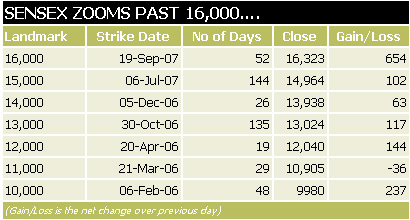
The Sensex opened with a bang at a new all-time high of 15,941 - up 272 points from its previous close - on the back of positive global cues. The US Fed, on Tuesday, cut its benchmark rate by 50 basis points, for the first time in four years, to 4.75%. A move that resulted in a strong rally across the globe. The buying momentum was so strong that the Sensex soon crossed a new landmark of 16,000, and went on to extend gains as the day progressed. The index hit an all-time, intra-day high at 16,335 - up 666 points from the previous close. The Sensex finally ended with its biggest-ever single-day gain of 654 points at 16,323.

The index took only 52 trading sessions to move from 15,000 to 16,000. While the BSE Mid-cap index advanced nearly 2% to 7117, the Small-cap index added 1% to 8871. The BSE Realty index surged 5.8% to 8465. The Bankex and Oil & Gas indices rallied nearly 5% each to 8691 and 8924, respectively. The market breadth was positive - out of 2,850 stocks traded, 1,541 advanced, 1,233 declined and 76 were unchanged.
BIG MOVERS… All the Sensex stocks ended with gains today. HDFC and HDFC Bank zoomed nearly 8% each to Rs 2,354 and Rs 1,326, respectively. Bharti Airtel soared 6.5% to Rs 886. ONGC surged 6% to Rs 902, and Maruti was up 5.8% at Rs 926. Reliance rallied 5.5% to Rs 2,173. Reliance Communications and ICICI Bank gained 5% each at Rs 564 and Rs 970, respectively. Tata Steel and Bajaj Auto moved up 4.7% each to Rs 745 and Rs 2,512, respectively. While Mahindra & Mahindra and SBI advanced 4.5% each to Rs 741 and Rs 1,770, respectively, Tata Motors and ITC added 3.7% each to Rs 722 and Rs 187, respectively. Hindalco and Infosys were up 3% each at Rs 159 and Rs 1,853, respectively. ACC surged 2.7% to Rs 1,153.

MOST ACTIVE COUNTERS DLF topped the value chart with a turnover of Rs 255.70 crore followed by Reliance (Rs 227 crore), ICICI Bank (Rs 148.70 crore), Reliance Capital (Rs 137.65 crore) and Renuka Sugar (Rs 127.80 crore). IKF Technologies led the volume chart with trades of around 1.85 crore followed by Ispat Industries (1.82 crore), Balrampur Chini (1.08 crore), IFCI (89.70 lakh) and Himachal Futuristic (87 lakh).

Sensex at16000: Experts say more gains to follow The Sensex closed above 16,000-mark for the first time, and market experts feel more gains will follow with some hiccups on the way.Though nobody is taking a call on where the index will be in the near-term, experts, across-the-board, continue to be bullish on Indian equities.

Nimesh Kampani, chairman, JM Financial : The basic issue is that the way the markets have gone up. The flow of FII money will increase in India and that is the expectation of the market. With the interest rates being cut, the appreciation of rupee, and looking at the rise in Asian markets today, it can be assumed that there has been a flow of FII money into the Asian markets. Sectors such as infrastructure, cement, steel and power look good, as we expect growth in these sectors.

Rakesh Jhunjhunwala, billionaire investor and stock trader : I’m and I have been bullish on the Indian markets. There is no change in my view

S Ramesh, COO, Kotak Investment Banking : Markets will be driven by liquidity, and money will move into markets like India where the growth story remains intact. The rise from this level will be driven by sectors like banking, construction and engineering. We are just coming out of a global meltdown, and the rise from here will be sector-specific and global-event driven.

Krishnamurthy Vijayan, CEO, JP Morgan Asset Management : We believe that since India is one of the best investment opportunities in the next few years, we will continue to attract investments - onshore and offshore. We have been consistently overweight on sectors that capture the Indian growth story, and have been underweight on auto and downstream oil.

Vijai Mantri, CEO, Deutsche AMC : We are very positive on India. The Indian growth story is completely driven by domestic demand. While there may be some bouts of volatility, I don’t see any constraint on corporate earnings growth. We are very bullish on capital goods, engineering and power. I think Indian markets are fairly valued but India may see a rate cut taking cues from FOMC.

Alok Vajpayee, CEO, Dawnay Day AV : The Indian market is following the global trend. I will not be surprised to see it at a much higher level. Some ups and downs will be there, but we will continue to see markets moving up. There could be a rate cut in India. There is lot of momentum in liquidity in Indian markets and I think they are at a fair valuation. Investors should look at specific companies rather than across-the-board buying. Second quarter results will be in line with our expectations.

Ramesh Damani, member, BSE : Markets have clinched 16,000 with a huge bang. Bulls are going to be in command. It reflects the strength of the Indian economy. We can say that it is India’s time under the sun. The road from here onwards looks very good. India’s domestic story is being driven by corporate fundamentals and earnings that are very strong. I am bullish on domestic sectors like logistics, cement, banking and underweight for the time being on technology. May be by Diwali this year, we can expect a rate cut.

Amar Ambani, Vice President (research), India Infoline : The 50bps rate cut by the Fed, the first in over four years, has keyed up global markets as well as Indian equities with investors breathing a sigh of relief. Talking about Indian markets in particular, the Fed cut, along with control over inflation and an improved political situation, has helped boost enthusiasm. A look at the advance tax figures also suggest that quarterly numbers are likely to be healthy. The feel-good factor of the Fed verdict will continue for some more time with increasing inflows in India where there are some very good investment opportunities.

Suyash Choudhary, Fund Manager, StanChart Asset Management : By delivering a 50 bps cut in the federal funds rate yesterday, the Fed has aimed at countering the detrimental effect on the broader economy arising from the tight credit conditions. The move has been accompanied by a cut by 50 bps on the discount window, which will further facilitate liquidity transmission into the financial system. While bonds world-wide are still cautious, equities have reacted very positively to the Fed move. Given that the move will help in restoring global financial stability, it is likely to positively affect domestic asset markets as well.

Ritesh Jain, Fund Manager (Debt), Principal Mutual Fund : The change in the Fed policy reinforces our near-term view on the benign interest rate environment. Inflation risk should continue to subside in this environment and will lend an element of flexibility to policy. The foreign flows in emerging markets may look up putting pressure on the domestic currencies to appreciate. The central bank may have to intervene aggressively to stem the uptrend in local currencies adding to domestic liquidity. While equity flows into emerging markets are likely to be good, the markets will also be watching for the corporate earnings in the current quarter. We expect the markets to remain strong. With the global interest rate environment turning benign and with most of the prominent central banks changing their stance in favor of growth than their concern on inflation, we may see even the domestic yield curve shifting lower over a period of time.

Kaushal Sampat, Chief Operating Officer, Dun & Bradstreet India : The cut in the Fed rate is likely to have some impact on the Indian economy. The widened interest rate differential between India and the US could result in a further surge of capital inflows (especially FIIs), which may lead to an appreciation of the rupee. The RBI may be under pressure to intervene in the forex market to preclude appreciation of the rupee beyond its comfort zone. The RBI could consider a decline in interest rates given the recent dip in the growth rate of industrial production and inflation being at a 17-month low thereby allowing the excess liquidity to flow into the economy through increased credit off take.

Sandeep Nanda, executive vice president (research), Sharekhan : The 50bps rate cut by the US Fed was ahead of expectation and thus a positive surprise. This prompt action has allayed concerns about a slowdown and will be positive for equities across the world including India. We expect cyclical and interest rate sensitive sectors such as banks, autos, metals to do well. There will now be greater pressure on the RBI to cut interest rates in India, which should boost earnings growth in FY2009.

Kunj Bansal, CIO (portfolio management services), Religare : With the FOMC announcing a 0.5% cut in the rate, the debate of an impending slowdown in the US has only increased. Moreover, the exact magnitude of the subprime crisis is yet to play out. Signals from Europe and Japan are not as salutary as they were in July. Crude has resumed its relentless pursuit of a three-figure price after a brief pause. These developments portend a steady increase of lows to those economies, which are essentially growing due to the domestic demand factor.

Therefore, India would stand to benefit as a consequence. That does not mean that everything is fine in the domestic space and that we are likely to see an out performance across sectors. The political undercurrents are far from positive. Further, the latest set of IIP numbers has revived the talk of a possible slowdown in the industrial growth going forward. The performance of the monsoon, on the other hand, has given sufficient reason for cheer. In essence, what we are saying is that whereas directionally there is nothing much to worry as far as the way forward is concerned, and the markets shall continue their northward journey. However, intermittent blips cannot be ruled out.

Ventura Commodities : Watch what the Fed does, and not what they say

It’s pretty clear now that US economy is facing problems on credit front and investors can expect that the Fed would not fight inflation at the expense of growth. But is Fed doing enough to restore the falling investors confidence??? Fed came to rescue of bankers by flushing billions of dollars into the system. Credit crunch that has roiled global financial markets, forced Fed to act on the deteriorating credit situation by cutting the Discount rate by 0.5%.

“ Discount Rate is nothing but the interest rate that an eligible depository institution is charged to borrow short-term funds directly from a Federal Reserve Bank”

The discount rate cut will not help the markets to ease the liquidity fear, as it is still one-half point higher than the funds rate, which is at 5.25 percent. That means that banks must pay the Fed more for direct loans from the discount window than they have to pay other banks to borrow for them on an overnight basis. The Federal Reserve reported that the daily borrowing averaged $1.315 billion for the week ending Wednesday. That was the highest average borrowing since the attacks of Sept. 11, 2001. The data released by the Fed helps us to know how banks are responding to the Fed’s encouragement for banks to borrow directly from the central bank through a loan facility know as the Discount Window . Four of the nation’s biggest banks — Citigroup Inc., JPMorgan Chase & Co., Bank of America Corp. and Wachovia Corp. — announced they had borrowed a total of $2 billion. ECB has followed Fed and has poured billions of Euros into the system, who is also facing liquidity problems due to sub prime mortgage default With so much of ongoing crises Fed fund rate cut expectations are hardening. Fed fund rate the interest banks charge each other — has been at 5.25 percent for more than a year. A reduction in this rate translates immediately into a cut in commercial banks’ prime lending rate, the benchmark for millions of consumer and business loans. The prime rate currently stands at 8.25 percent. Will the market bounce back even if Fed cuts the rate by 0.25 or 0.5 bps? It will definitely ease some pressure from banks but will banks pass on the benefit of rate cut to end consumers by slashing their PLR? Will Fed be able to restore the investors’ confidence? Confidence game is such a difficult one… Once the market is convinced it can trade without fear, players will come out, one by one, to deal again. But confidence isn’t there yet. Credit crisis is deeper and more dangerous to the economy than anybody realizes it.

“The only thing that is certain is that more uncertainties in the direction of asset prices and volatility are on their way”

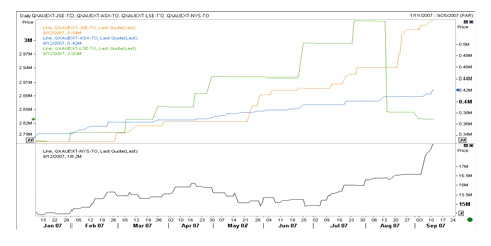
Effect on Gold Gold ends its suffocating trend last week when it broke the psychological resistance of $700 rallying upside till $723 (on 11 th Sep’07). Technical break out led to heavy buying among gold investors. The upshot is that if the markets decide that the gold price deserves to be higher then the gold price will go higher regardless of direct intervention by the Fed or any other central bank. The main driver of this rally is ETF; heavy buying is seen from gold Exchange Traded Funds. New York’s StreetTRACKS reported heavy buying, as on date (12 th Sep’07) it holds 566.95 tonnes. From the chart its pretty clear that investors are parking money in gold ETF. Gold seems to have regained its safe haven role during financial market turmoil. We expect robust buying from gold ETF to continue in near future.

Current Fundamental reasons leading gold to rally are: - Weak Dollar: - The current gold rally is being driven primarily by fears that the debt crisis will lead to a breakdown in the Dollar Index and secondarily by the contraction of liquidity. Dollar is further likely to face the pressure against the euro as investors bet the U.S. interest-rate advantage over Europe will narrow amid the housing market slump. U.S. existing home sales will fall 8.6 percent in 2007, exceeding the 6.8 percent drop estimated a month ago, according to the National Association of Realtors. Problem is further likely to occur if Fed cuts the fund rate, which market is desperately waiting for on 18 th Sept 2007. Over all weak dollar outlook is likely to keep gold upside intact.

Unemployment: - The dollar slid to a 15-year low against a basket of currencies after data showed U.S. employers cut jobs for the first time in four years stoked expectations for a hefty Federal Reserve rate cut this month. Companies cut 4,000 jobs last month, the first such decline since August 2003. The unemployment rate remained at 4.6%, large number of people dropped out of the labor market. The report, raised fears that the plunging housing sector and worldwide turbulence in financial markets could push the economy toward recession. The August decline in employment centered in the goods-producing sector of the economy. The construction industry lost 22,000 jobs during the month, while factory payrolls plunged by 46,000. Manufacturing employment has fallen by 215,000 in the past year. Factory job declines in August went beyond housing, including auto plants and semiconductors, as well as wood products and furniture.

Rise in Physical Buying: - Global gold demand increased 11 per cent in the first half of the year, compared with the same period a year ago, despite high prices, according to the World Gold Council. Demand for gold jewelry showed the strongest surge reaching record levels in the second quarter of 2007 rising 37% y.o.y. on the back of strong demand in India, China the Middle East and Turkey. Heavy buying is expected from India with upcoming festival season. Physical buying has not catched up the pace it should due to concerns in international markets. Traders are waiting for a dip in prices to stock gold for festive season. India’s total gold holdings under exchange-traded funds rose in August compared to the previous month. Total gold holdings under the ETFs were at 3.33 metric tonnes at the end of August, up from 3 tonnes in July.

Dehedging on rise: - Gold miners typically hedge more — contracting to sell nuggets not yet mined at fixed prices — when they think bullion prices are in long-term decline. Rise in Dehedging from mining companies has further supported bullish trend in gold prices. Australia’s Newcrest Mining Ltd. said its gold buying spree that scooped more than 2 million ounces of gold in the last few weeks had helped fuel a sharp rise in world bullion prices. Newcrest planned to buy a further 1.7 million ounces of gold over the next 12 months as part of its plan to exit its gold hedges. Dehedging is anticipated to range between 2.5 to 3.5 million ounces (78 to 109 tonnes). The pace is expected to slow in the second half of the year. Dehedging is currently in the range of approximately 8 to 10 million ounces (250 to 310 tonnes). [Source GFMS]

Crude Oil breaches $80 mark: - Gold was further supported by high oil prices recently due to ongoing problems on refinery and supply fronts. Though OPEC ministers agreed to boost output by 500,000 bpd effective Nov. 1 at their regular meeting in Vienna in a bid to keep oil prices under control, series of attacks on Mexico’s fuel pipelines this summer has raised fears the key energy supplier could struggle to keep its oil and gas flowing. Analysts expect rising instability in Mexico, a normally reliable supplier, could add as much as $10 a barrel to world oil prices. Violence in big oil producer nations in the Middle East, Africa and Latin America has helped drive red-hot oil markets. Such many more attacks on oil fields would likely have a more significant impact on the global oil markets. Investors often turn to gold as a hedge against inflationary signs, including high oil prices. Indeed, while countries like India, China and Brazil still use much less oil than the developed nations, especially on a per capita basis, they are responsible for much of the growth in global demand for crude. This has led to projected strong demand for crude over the next few years, and concerns that supplies will not be able to keep up the pace, we expect crude to remain strong for coming days thereby supporting bullish trend in gold.

(Areas of concern) Hedge Fund Losses: - Hedge funds, deploy leverage to enhance their exposure to markets, When things are moving in the right direction this results in phenomenal profits. However, the ‘bets’ get bigger and bigger and its only a matter of time before the ‘gamblers’ find themselves on the wrong side of the market. It was the case with Two of Bear Stearns Hedge funds, which placed highly leveraged bets on packages of subprime mortgage derivative products. When the value and credit worthiness of these bond packages called collateralized debt obligation (CDO’) was cut due to the subprime defaults, Bear Stearns virtually wiped out the total value of the funds that had previously been rated as low risk. The CDO packaging enabled institutions to mix good risk and bad risk debt all in one box and label it as good risk. Therefore the financial institutions earned a higher rate of return on what seemed like a relatively low risk CDO package. Bear Stearns weren’t the only people betting on the subprime mortgage market using highly leveraged derivatives.

“As per Moody’s Investor Report there’s a roughly 50% chance of a big fund collapse”

As per the Report there are many hedge funds that are likely to collapse further due to there over leveraged positions and could further disrupt the market. It is unknown how much damage will be done, but the downtrend in financial market will be the clue that one should keep an eye upon. As financial institutions are forced to ‘cover their bets’ by making provisions for bad debts, they are in effect withdrawing liquidity from the market place and making it more difficult for borrowers across the board to borrow money for whatever economic activity. This means that it will have greater impact on the economy and thus depress the US housing market further.

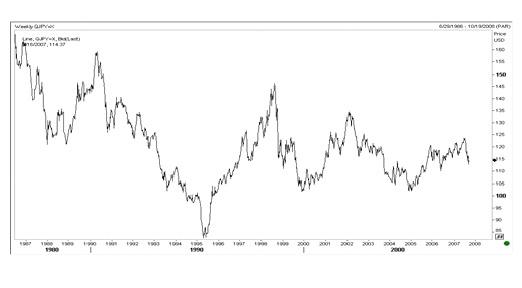
(Areas of concern) Unwinding of Carry Trade: - The low borrowing costs of the yen is responsible for financing massive bets in a variety of high-risk markets such as commodities and emerging markets. The carry trade is expected to be reversed as the Japanese economy strengthens and prices begin to rise. Over the past few years, the financial markets have become very speculative and highly leveraged. Risk appetite is plunging as investors bail out of nearly all assets. Investors’ risk appetite fell sharply in recent sessions on fears of the potential knock-on impact from subprime lending market woes. Risk aversion is rocketing today.

There are no official statistics on the size of the carry trade. Some economists estimate the total size could range from $200 billion to as high as $1 trillion. The whole system is reliant on Japanese interest rates remaining low and the Yen weak. If the yen strengthens then the value of the debts increases and thus a rush for the exit as people look to liquidate positions further strengthening the yen and carry trade losses. A sharp reversal of these positions would have significant negative impact on financial markets. We expect Yen unwinding to further continue thereby taking yen to Y108.9/ dollar (till this year end).

(Areas of concern) CBGA Sales: - Gold can face some pressure from European Central Banks sales under CBGA. Though ECB will be falling short of there quota (500 tones/year) this year, we expect Italy, Spain, & Swiss Bank to be the major sellers in 4 th year of the CBGA agreement. Switzerland announced relatively recently that it planned to sell 250 tonnes of gold by the end of the 2009 sales period. The Italian parliament approved a reserve plan allowing the government to look into using the Bank of Italy’s substantial gold reserves to cut the country’s huge debt. Italy has some 62% of its foreign exchange reserves value in gold at about 2,452 tonnes. Italy’s debt is the world’s third highest in absolute terms. Part of the gold and currency reserves of the Bank of Italy will be used to attack Italy’s enormous national debt, currently the equivalent of 107 per cent of GNP. But in recent times despite of heavy gold sales from ECB under CBGA we could see that market could very well absorb the selling pressure which is a good sign for gold investors. But one cannot rule out the impact the central bank selling can have on the gold market. We expect robust selling from ECB in 4 th year of the CBGA Agreement.

(Areas of concern) Strengthening of Rupee: - Strengthening of Rupee is another gauge for gold prices to rise domestically. Government is likely to intervene to keep rupee above 40 levels in order to protect the interest of exporters. We expect rupee to consolidate around INR 40/ dollar with upside potential till INR 38.5/ dollar.

Conclusion From investors point of view one should keep an eye on “What Fed does and not on what they say” . Fed has hardly done anything to restore confidence not only among consumers but also among banks as banks are refusing to deal with one another hits at the heart of the entire system.

We expect two events in next week: -

  • 1. Fed might cut the Fund rate by 0.25% (which every one is expecting) OR
  • 2. Fed might cut discount rate by 0.5% (from 5.75% to 5.25%)

We think Fed might not cut the interest rate and could opt for 2 nd option of cutting the discount rate by 0.5%. One needs to wait and watch what action Fed takes on 18 th Sept 2007. If Fed does not cut the Fund rate we expect gold premium that has been built on the expectations of rate cut, to come down drastically. And if it does cut then gold can breach previous 26 years high of $732.

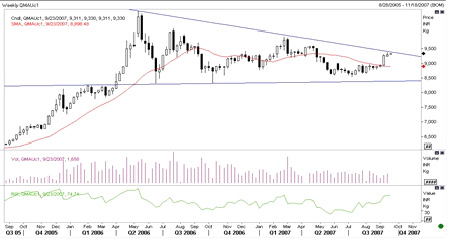
Technical Comments: - Gold has been trading consistently above $700/ounce for past two weeks. MACD is above the zero line indicating further bullishness in gold. We expect upside rally to continue with some correction as gold is trading in overbought zone. All eyes will be on FOMC announcement on 18 th Sept 2007. Gold can face some resistance around $733. Two consecutive close above $733 opens ground for $773 level. We eye support at around $698 and good trendline support at $683, which is also 100 days moving average. On short term basis two consecutive close below $712.5 can take gold to $698 level. Overall trend remains bullish, These are the following trading strategies: -

  1. If Fed Cuts Funds Rate: - Buy MCX Gold Oct contract above 9410 for target of Rs.9590/9850 with stop loss at Rs.9275 (Call is on closing basis)
  2. If Fed doesn’t cut Fund Rate: - Sell MCX Gold Oct contract below 9245 for target of Rs.9125/9045 with stop loss at Rs. 9340/-(Call is on closing basis)

Investment in equity shares has its own risks. Sincere efforts have been made to present the right investment perspective.The information contained herein is based on analysis and up on sources that we consider reliable. I, however, do not vouch for the accuracy or the completeness thereof. This material is for personal information and I am not responsible for any loss incurred based upon it.& take no responsibility whatsoever for any financial profits or loss which may arise from the recommendations given in this blog.

Thursday, September 6, 2007

ICICI Direct : Buy Adhunik Metaliks (ADHMET)

(BSE: 532727 | NSE: ADHUNIK | ISIN: INE400H01019)

Company Background Adhunik Metaliks Ltd (AML) is the flagship of Rs 1,000 crore Adhunik Group based in Kolkata with manufacturing facilities at Rourkela, Orissa. The company began operations as a sponge iron manufacturer in FY04 and set up a pig iron and steel-making facility in FY06. The company is undertaking an expansion that would fully integrate it over the entire value chain. At present, the company has a capacity of 250,000 tonnes per annum (tpa) with sponge and pig iron capacities of 150,000 tpa and 187,500 tpa respectively, and carbon and alloy billet capacity of 250,000 tpa.

Investment Rationale Capex to transform business model AML is implementing a capex programme that would change its business profile from a secondary steel manufacturer to an integrated steel player with linkages across the entire value chain from critical raw materials such as iron ore and coal to value- added steel products. It is also creating an integrated business model that would give it more control over critical raw materials like iron ore and coal. It is also integrating forward in an effort to lower earnings sensitivity due to product prices. post expansion, we expect the company to emerge as one of the lowest cost integrated special steel manufacturer in the country by 2008.

Capacity to almost double The company is executing an expansion plan that would almost double its capacity from 250,000 tpa to 440,000 tpa by 2008. It has set up a sponge and pig iron capacity of 150,000 tpa and 187,500 tpa respectively, along with a continuous casting unit for manufacturing billets (alloy steel). We expect that the expansion would result into high realization from the value added product, as prices in this segment are higher and more stable than base grades products.

Backward integration to drive profitability The company is integrating backwards with captive ownership of critical raw materials, viz. iron ore and coal mines which would enable it to withstand pricing pressures and face competition better compared to its peers. It would insulate the company from a sustained upward pressure on iron ore & coal prices. In addition, it is setting up a power plant, which would lower its dependence on the grid power. This integration would result in annual combined savings of about Rs. 50 crore annually.

Risk and Concerns Steel is subject to price fluctuations and in the last eighteen months, global steel prices have come off their top. Global steel prices may soften further due to lower Chinese steel consumption, post-2008 Olympics which would have an adverse impact on company’s earnings and valuation as well.

Financials In FY07, the company reported a top line of Rs 735.76 crore and bottom line of Rs 77.48. In Q1FY08, sales grew 21.86% y-o-y to Rs 208.12 crore, while bottom line grew 14.22% to Rs 17.75 crore. During the quarter under review, the company acquired Orissa Manganese & Minerals Pvt Ltd as a 100% subsidiary, which has mining rights with reserves of 15 million tonnes for manganese ore and 35 million tonnes for iron ore. These mines do not have captive clause and the manganese ore and iron ore can be sold in the open market to various end users. We expect the benefits from these mines to accrue partially this year and for the full year of FY09. The integration and acquisition of mines would drive the company’s top line at a CAGR of over 40.70% during FY06-09E to Rs 1,180.37 crore and bottom line at a CAGR of around 59.58% to Rs 137.00 crore.

Valuation The company is expected to double its top line and quadruple its bottom line on the back of capacity expansion into high margin value added products along with the backward integration into critical raw materials such as iron ore and coal. At the current price of Rs 75, the stock is trading at 6x the FY09E EPS. We expect the integration and the mines acquisition, to drive the growth momentum going forward and expect the stock to touch Rs 90, an upside of 20%, within a 3-6 month timeframe..

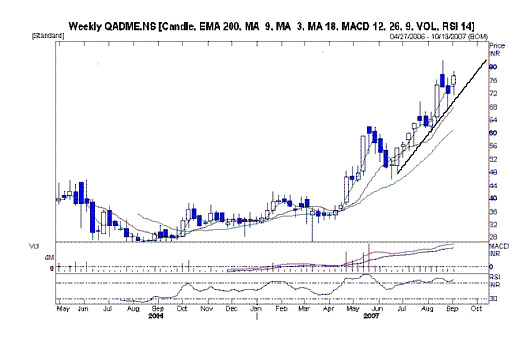
Technical Outlook The stock has been in a strong uptrend since April this year. The weekly charts display good support on the rising trend channel. The stock has shown a bullish candle in the previous week, which is positive. The stock is likely to test new highs as the RSI momentum indicators have began moving up.

Other Info: Corporate Announcements | Board Meetings | Financial Results | Corporate Actions
Company Address | Shareholding Pattern | Results Comparison

Every week, the ICICIdirect recommends a stock based on fundamental and/or technical parameters, which is likely to give a return of 20% or more over a 6 month perspective.

Investment in equity shares has its own risks. Sincere efforts have been made to present the right investment perspective.The information contained herein is based on analysis and up on sources that we consider reliable. I, however, do not vouch for the accuracy or the completeness thereof. This material is for personal information and I am not responsible for any loss incurred based upon it.& take no responsibility whatsoever for any financial profits or loss which may arise from the recommendations given in this blog.

Monday, September 3, 2007

ICICI Bank mandates 10 international banks for $1.5 b loan

Close on the heels of raising $5 billion through a public offer, country’s largest private lender ICICI Bank has mandated ten international banks to arrange a Japanese Yen equivalent loan of $1.5 billion (about Rs 6,100 crore).

The funding would be the biggest-ever offshore syndicated loan facility by an Indian financial institution and is likely to be announced tomorrow, sources said.

The funds would be used for general corporate purposes. The ten banks mandated for the funding include BNP Paribas, Galyon, Goldman Sachs, HSBC, Standard Chartered Bank and Sumitomo Mitsui, the sources added.

When contacted, an ICICI Bank spokesperson declined to comment on the issue.

The debt raising exercise follows the bank’s follow-on public offer in domestic and international markets in June this year.

ICICI Bank had raised about Rs 10,000 crore from the domestic market through issue of equity shares, and an equivalent amount through a secondary offering of American depository shares in the US.