Tuesday, August 28, 2007

ICICI Direct : Buy Man Industries (India) (MANIN)


(BSE: 513269 | NSE: MANINDS | ISIN: INE993A01018)

Company Background Man Industries (India) Ltd, the flagship company of the Man Group, UK, manufactures steel line pipes for high and medium pressure applications such as oil and gas, petrochemical and water transportation, anti-corrosion coating systems and aluminum extrusion products. The company started operations in 1989 as an aluminium extrusion company with an installed capacity of 4,000 tonne per annum (tpa). In 1994, it set up a Submerged Arc Welded (SAW) pipe plant in Pithampur, Madhya Pradesh. In 1998, it became an integrated SAW pipe manufacturer with its own polyethylene-coating facility as part of its forward integration plan. It also set up a spiral pipe-making mill. In FY05, the company expanded capacity by setting up another plant in Anjar, Gujarat. Post expansion, the combined capacity increased to 2,000 km of pipes per annum.

Investment Rationale Robust global demand boom Demand for SAW pipes is likely to remain firm in next five years due to burgeoning crude prices and depleting oil reserves. We expect global demand to be in the range of 67 million tonnes with around 66% flowing in from Middle East, Asia & US, the key markets for the Indian players. While demand in Europe and Russia would be met by internal supplies, demand in Middle East and US is likely to be met through imports. This high demand, coupled with supply constraints, would keep prices firm at for least two years through CY08 and 09, escalating to mid 2010, where after it may start softening.

Diversification the key attraction Man Industries’ business would be split equally between LSAW and HSAW pipes from December 2007. HSAW pipes are manufactured from hot-rolled (HR) coils, which is easily available at comparatively lower price. In contrast, LSAW are manufactured from plates, which are in short supply. Though the two types of pipes are interchangeable, the high price of LSAW pipes may put pressure on demand. The diversification would de-risk its business. Despite their high price, we believe LSAW pipes would continue to score better than the HSAW in terms of profitability as manufacturing cost of LSAW is around 50% that of HSAW. Further, the scrap generated from LSAW is also minimal. The yield in HSAW is 90-96% while that in LSAW is as high as 99.5 100%. Currently, the difference in prices for plates (raw material for LSAW) and hot rolled coils (raw material for HSAW) is between US$250-300 per tonne for different grades of steel. A lot of units to manufacture plates are being set up and we expect prices to decline in the next few years. We expect prices of plates to fall and the price differential between plates and coils will decline to US$0-100. We believe lower raw material prices would result in LSAW prices decline.

Timely capex, robust order book gives earning visibility Man Industries is in capex mode and post expansion, its capacity of 1 million tonnes would be more than 2x the existing capacity, equally distributed between LSAW and HSAW pipes. This would reduce the risk and increase the size of addressable market. With a robust order book position of Rs 2,400 crore, we expect the top line to grow at a CAGR of 51% over FY07-09E and net profit by 67%. Capacity utilization should be at about at 40% in FY09E.

Risk and Concerns Man Industries exports its products mainly to companies in the Middle East. About 90% of the current orders are from abroad. Any appreciation in the rupee could impact the company’s financial performance. Freight cost is an important cost for pipe manufacturers. A rise in freight charges could the bottom line. Capacity expansion by other players around the world or by new entrant may put pressure on realizations. A large number of players could result in the bargaining power of buyers increasing and manufacturers would not be able to pass on rises in raw material costs to buyer.

Financials In FY07, the company reported a top line of Rs 1,133.10 crore and a bottom line of Rs 55.30. In the Q108, sales grew 54% y-o-y to Rs 320.99 crore while bottom line grew 67% y-o-y to Rs 17.35 crore. The plant at Anjar started operations whereby the company increased the execution of new orders. Moreover, the company also witnessed traction in capacity utilization to around 45% on the current capacity of 600,000 tpa. From Q408, we expect the company would operate at the total capacity of 1 million tonnes. We expect the robust order book to drive the company’s top line at a CAGR of over 51% during FY07-09E to Rs 2,116.25 crore and bottom line at a CAGR of around 67% to Rs 153.71 crore.
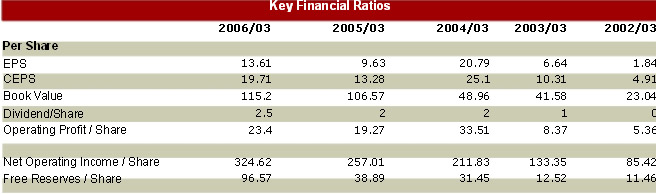
Valuations Man Industries is set to capitalize on the rising global demand for pipelines. At the current price of Rs 255, the stock is trading at 4.42x the FY09E EPS. We expect orders from oil & gas clients to drive the growth momentum going forward and expect the stock to touch Rs 306, an upside of 20%, within a 3-6 month timeframe.

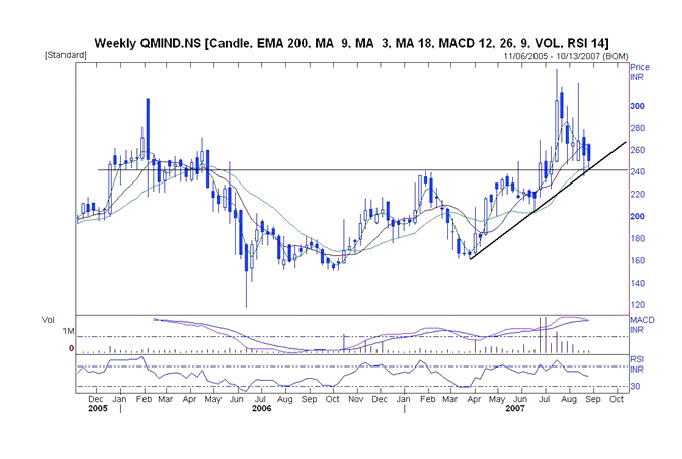
Technical Outlook The stock has broken above a long-term resistance at Rs 240. It had thereafter hit a high of Rs 320. It has now begun consolidating and is finding support at Rs 240. It has also formed a bullish rounding bottom formation. Momentum indicators remain in overbought zones. They are expected to come down after the consolidation before the next bullish impulse begins.
Other Info: Corporate Announcements | Board Meetings | Financial Results | Corporate Actions
Company Address | Shareholding Pattern | Results Comparison

Every week, the ICICIdirect research team selects a stock based on fundamental and/or technical parameters, which is likely to give a return of 20% or more over a 3-6 month perspective.

Investment in equity shares has its own risks. Sincere efforts have been made to present the right investment perspective.The information contained herein is based on analysis and up on sources that we consider reliable. I, however, do not vouch for the accuracy or the completeness thereof. This material is for personal information and I am not responsible for any loss incurred based upon it.& take no responsibility whatsoever for any financial profits or loss which may arise from the recommendations given in this blog.

Monday, August 20, 2007

NTR Yamadonga Review!

katha:Donga ga chinnappude career start chesthadu Raja(NTR flashback lo).oka santha lo Zamindar grand daughter Maheswari(little Priyamani)ni rakshisthadu.
fast forward chesthe...
Zamindar chanipoyaka Maheswari ni pani pilla kante darunam ga treat chesipenchutharu Idharu Mavayyalu(Jayaprakash Reddy,Raghu babu).Maheswari ni champesi Zamindar property motham kotteyyalani plan chestharu.Donga ga manchi form lo unna NTR,Ali oka gown kottesi ivvataniki MS Narayana tho Rs.10Lakhs deal kudurchukuntaru.aa pani lo unna NTR,Ali anukokunda Priyamani ni save chestharu.12 years tarwatha malli save chesina NTR ni love chesthundhi Priyamani.Zamindar family ki Priyamani ni appaginchi Rs.50Lakhs tesukundham ani plan chestharu NTR,Ali.
Gown dorikina excitement lo MS Narayana chanipothadu.Rs.10Lakhs raledhani feel avuthu MS Narayana ni ,MS ni teesukellipoyina Yamudu(Mohan Babu) ni boothulu thidathadu NTR.Kopam vachina Yamudu NTR ki narakam chupinchalanukuntadu.Priyamani Mavayyalu chethilo murder ayipoyi Yamalokaniki vasthadu NTR.Akkada evaru evariki Narakam chupincharu ? Maheswari love story emayindhi anedhi remaining story.Highlights:
NTR-Rajamouli combination lo high expectations tho vachina Yamadonga almost expectations ni reach ayindhi.
NTR Rocks in every aspect.Rajamouli created this subject only for NTR.Yamudi ga NTR acting superb.Yamudu ga NTR cheppe dialouges ni Dana Veera Sura Karna lo Legend NTR dialogues,NTR public speeches format lo create chesaru.NTR succeeded in reminding his grand father.Dance gurinchi 'manchi EASE undhi,manchi EASE tho chesadu'ani regular ga vintu untam.But no one knows what it is exactly.EASE ante ento Yamadonga lo NTR dance chusthe artham avuthundhi clear ga.
past 10-12 years lo 2 cinemalu(Pedharayudu,Rayalaseema Ramanna Chowdary)tappa Mohan babu acting talent,dialogue delivery ki tagina cinemalu ,charecters raledhu Mohan babu ki,aa chance malli Yamadonga tho vachindhi.Intelligent casting by Rajamouli,excellent performance by Mohan babu.
E cinema ki Man of the Match Rajamouli.Yamagola,Yamudiki Mogudu,Yamaleela--3 block busters vachina concept ni,andaru chusesina concept ni malli 12 years tarwata kotha ga cheppatam ante easy kadhu.Rajamouli succeeded in narrating it fresh and entertaining .Storywise it is not upto the mark with the above three but entertainment wise it is on par with all the above.That's the magic of Rajamouli.
MM Keeravani music (songs& rerecording)is first class.NTR Yamudu getup lo kanipinchinappudu Dana Veera Sura Karna lo Duryodhanudu ki vadina background score ni recreate chesaru Keeravani.
The movie is visually rich and colourful.Yamadonga is one of the most expensive film in Tollywood History.Normal ga producers pettina expenses screen meedha complete ga kanipinchedhi rare cases lo.we can see it in Yamadonga.it is possible by coordination between art(creative&huge sets by Anand Sai)-camera(excellent lighting done by cinematographer Senthil)-styling(Rama Rajamouli) departments.Graphics bagunnayi.
Mamata Mohandas,who was ousted from two big films earlier,proved those film makers are wrong.She proved her talent in Yamadonga,she looks cute.Priyamani is Ok.
Comedians-Brahmanandam,Ali,MS Narayana,Raghubabu done their job well.
And above all--It is Legend NTR's appearance for 2 minutes got the biggest applause.NTR appears in Gajadonga getup.It's a feast for Nandamuri fans to watch Legend NTR and NTR jr. dancing for lyrics Aanati Ramudu,eenati Manavadu...Animation,compositing,dialogues everything were well done.

Side lights:
Story wise goppa cinema emi kadhu.
Lengthy film(3hours).
The pace was down a couple of times in the second half,but bore anipinchadhu.Director dramatised the screenplay towards the climax to add a bit weight to the subject(Fun alone,like Yamagola,can't survive these days).This might leave a feeling to some sections of audience a bit let down compared to the first half which is totally entertaining.
Much expected O lammi thikka reginda...song was a let down visually.situation and picturisation are not upto the mark.

Public Talk: Bagundhi,Must watch
Industry Talk:Superhit

ICICI Direct : Buy NTPC - National Thermal Power Corporation

(BSE: 532555 | NSE: NTPC | ISIN: INE733E01010)

Company Background NTPC is the largest thermal power generating company in India . A public sector company, it was incorporated in 1975 to accelerate power development in the country. At present, the government holds 89.5% of the total equity and balance 10.5% by domestic banks, FIIs and public. Over the last three decades, NTPC has emerged as a national power company, with power generating facilities in all the major regions of the country. NTPC’s share of the total installed capacity in the country as on March 31, 2006 was 19.51%. It contributed 27.68% of the total power generation of the country during 2005-06. During FY06, the company acquired a 28.33% stake in Ratnagiri Gas and Power Private Ltd (RGPPL) for Rs 500 crore. RGPPL is a joint venture between NTPC, GAIL, domestic FIs and the Maharashtra SEB Holding Co. Ltd. to take over the 2,150 MW gas-based Dabhol Power Project.

Investment Rationale Power sector on cusp of huge growth Although India ’s power generation capacity has increased substantially in recent years, it has not kept pace with the growth in demand or the growth of the economy generally. India ’s electricity consumption is amongst the lowest in the world at 569 units per capita in 2006. This contrasts with 1,484 units per capita in China , 2183 units in Brazil and 13,456 units in the US . To boost generation, the government has unveiled a plan to set up five ultra mega power projects of 4,000 MW each. Further, in a bid to improve fuel supply to power producers, it has allocated 26 coal blocks with reserves of 8,581 million tonnes and four lignite blocks with reserves of 755 million tonnes.

Expansion plans to drive future growth At present, NTPC has an installed power generation capacity of 26,194 MW. During the 11th Five-Year plan (2007-11), it plans to enhance the capacity by an additional 21,941 MW. We believe the massive capacity addition will help the company retain its position as the largest generating utility in the country. It already has the advantages of a high plant load factor (PLF), secured coal supplies and low receivables.

Backward integration to secure fuel supplies NTPC has a policy of entering into long-term tie-ups for its fuel requirements. It has now evolved a strategy for backward integration into coal mining and oil & gas exploration. We believe these steps will give it secured fuel supplies and also mitigate risks to its capacity expansion plans.

Proximity to fuel sources Most of NTPC’s coal-fired stations are located close to the mines that supply coal. We believe the proximity of its plants to fuel sources will help it generate electricity at competitive rates.

Diversification moving up the value chain The company plans to diversify its business by taking advantage of opportunities created by regulatory and economic reforms. It has ventured into power trading and is considering downstream integration into distribution business. It also plans to enhance its current consulting services capabilities in the domestic and international markets. We believe that these initiatives will enable the company achieve greater vertical integration and create new avenues for revenue and margin growth.

Risks & Concerns The Central Electricity Regulatory Commission (CERC) has issued new tariff regulations for the period from April 1, 2004 to March 31, 2009 , under which the post-tax rate of return on equity has been reduced to 14% from the 16%, which was allowed until March 31, 2004 . NTPC’s operations and expansion plans have significant fuel requirements. In case, it’s unable to secure fuel at competitive prices, its operational and financial performance could be impacted.

Financials We expect revenue from sale of electricity to increase to from Rs 26142.9 crore in FY06 to Rs 32,579.08 crore in FY08 as a result of the increase in commercial capacity by 7,290 MW, higher PLF of existing capacities and higher variable charges. We expect net profit to grow at a CAGR of 20.61% from Rs 5,825.30 crore in FY06 to Rs 10,226.80 crore in FY08 on account of a fall in depreciation, higher incentives due to high PLF and unscheduled inter-unit charge. We expect EPS to be at Rs 12.40 in FY08.

Valuations We believe NTPC’s aggressive capacity expansion, coupled with its high PLF and unscheduled interchange charge would drive earnings growth at a CAGR of 20.61% over FY06-08E and improve its RoE to 14.30% from the regulated 14%. Using a DCF valuation, we arrive at an intrinsic value of Rs 201 per share.

Technical Outlook The stock has been an outperformer in an otherwise weak market. It has been moving in a ascending triangle pattern and awaiting a breakout above the Rs 170 levels. The MACD indicator has been moving up smoothly and is finding support on the channel. The RSI is also finding good support. What is more encouraging is huge volume price up-moves in the stock in the last few sessions

Other Info: Corporate Announcements | Board Meetings | Financial Results | Corporate Actions
Company Address | Shareholding Pattern | Results Comparison

Click Here to Download Full research report

Click Here

gyanguru

Every week, the ICICIdirect research team selects a stock based on fundamental and/or technical parameters, which is likely to give a return of 20% or more over a 3-6 month perspective.

Investment in equity shares has its own risks. Sincere efforts have been made to present the right investment perspective.The information contained herein is based on analysis and up on sources that we consider reliable. I, however, do not vouch for the accuracy or the completeness thereof. This material is for personal information and I am not responsible for any loss incurred based upon it.& take no responsibility whatsoever for any financial profits or loss which may arise from the recommendations given in this blog.

Saturday, August 18, 2007

Investors suck out Rs 2,40,000 crore from Dalal Street

The US subprime mortgage meltdown has shaved off Rs 2,40,000 crore market capitalisation on the Bombay Stock Exchange in fourteen sessions. The benchmark Sensex has declined by 5.87% (900 points) from its peak of 15795 on July 24, 2007. Currently the Sensex is trading at 14500 levels. Dalal Street loses Rs 1.7 tn; loss on subprime woes hits Rs3.3 tn The Bombay Stock Exchange’s 30-share benchmark index Sensex on 16 August plunged by 642.70 points, its second biggest one-day fall in absolute value terms The Sensex opened with a huge negative gap of 416 points at 14,585 on the back of a sell-off in the global markets triggered by the subprime crisis in the US. The Sensex, after languishing over 500pts lower for most of the trading session, slipped again towards the close to a low of 14,345. The index finally ended with a hefty loss of 643 points at 14,358 - the second biggest loss in absolute terms in history.

The BSE Metal index slumped 6.5% to 10,300. The Bankex and Realty index plunged 5.5% each to 7421 and 6980, respectively. The Oil & Gas index hsed 4.5% at 7505. The Auto and FMCG indices dropped over 3% each to 4662 and 1855, respectively. Declining stocks beat advancing shares by a margin of over 2:1 - Out of 2,751 stocks traded, 1,869 declined, 842 advanced and 40 were unchanged today.

ALL FALL DOWN All the 30 index stocks ended in negative territory today. Tata Steel crashed over 10% to Rs 575. Bharti Airtel slumped nearly 7% to Rs 801. SBI, Hindalco and Reliance Communications plunged over 5.5% each to Rs 1,522, Rs 145 and Rs 495, respectively. ICICI Bank, Reliance and BHEL tumbled 5% each to Rs 832, Rs 1,739 and Rs 1,603, respectively. Reliance Energy and HDFC Bank dropped around 4.8% each to Rs 718 and Rs 1,094, respectively. Larsen & Toubro, ONGC, ITC, Tata Motors and Cipla slipped over 4% each to Rs 2,319, Rs 819, Rs 158, Rs 663 and Rs 183, respectively. Maruti and TCS shed 3.7% each to Rs 791 and Rs 1,088, respectively. Ranbaxy was down 3.4% at Rs 361. Bajaj Auto, Grasim, HDFC, Mahindra & Mahindra and NTPC declined around 3% each to Rs 2,310, Rs 2,793, Rs 1,885, Rs 658 and Rs 168, respectively.

VALUE & VOLUME TOPPERS Debutant IVR Prime led the value chart with a turnover of Rs 329 crore followed by Reliance (Rs 202 crore), Tata Steel (Rs 154 crore), DLF (Rs 150.30 crore) and Reliance Capital (Rs 116.70 crore). Nagarjuna Fertilisers topped the volume chart with trades of around 3.10 crore shares followed by IKF Technologies (1.44 crore), IFCI (1.43 crore), Bellary Steel (1.28 crore) and Reliance Natural (Rs 1.28 crore).

Mkts looking at cues from the US: Experts It was an extremely weak session for the markets as they ended in deep red tracking its global peers. The sub prime problem has impacted stock markets globally Dow has slipped below 13,000 level and Asia closed down 4-6%. Even European markets have opened in red. Also the yen has appreciated against the dollar and is trading at 115.

All the BSE sector indices were in deep red ranging between 3-5%. Banking, relaty and metal stocks are the worst hit space today. All the Sensex and Nifty stocks are in red. Top losers on the indices were Tata Steel & Sterlite down over 8%, Bharti Airtel down &VSNL down over 6% and BHEL & ICICI Bank down 5% each.

Sensex was down 642.70 points or 4.28% at 14358.21, and the Nifty down 191.60 points or 4.38% at 4178.60. Deven Choksey of K R Choksey Securities, says “As long as Sensex stays above 14,150, for the time being stability will take place around this level and maybe some recovery along with the global market recovery, as I would put it across. To begin with,on the upper side one will have to say that around 14,900 could be the crucial level after which only decisive upside will take place. But as of now, talking range wouldn’t make much sense because market opens with a gap. So if some positive cues coming today evening, then next morning one will find 300-400 point gap opening. So, to an extent, it is not making sense. But if one wants to take some kind of a cautious look, 14,150 would be the first level; if it breaks, then we will have some more selling coming in our market technically.”

Rajat Bose of rajatkbose.com says, “The notable feature of today’s price activity is that Nifty spot which was trying to cross 4,206 in the morning and it actually could not do that. This level is pretty much significant because this happens to be the100-day simple moving average level based on August 14 close. This level is acting today as a resistance and unless and until we see the Nifty crossing 4,206 and sustaining above that, I really do not think that we should be betting on a recovery immediately. On the other hand, the 200-day moving average levels are not very far away from here. 4,062 -4,050 are the levels for both, simple moving average and exponential moving average for the 200-day moving and that should act as a major support level as of now but whether one should buy into that support or not that is a difficult question because each time you thought of one should buy major support, you had a nasty surprise once you go into the evening. So I really do not have much confidence to buy. I even do not know whether one can do value buying here or not.

SV Prasad, Chairman of Chime Consulting says, “I’m not a great believer in market timings but I think I this kind of a market discretion is better part of valor though I always believe tops and bottoms are for fools. I still have a hold on for a little bit more to get clear signals, especially from the US markets. But if I were to stick my neck up out I would certainly look at Telecomm especially the leaders because their numbers are looking good maybe its good idea to look at some of the leading IT stocks as well because it looks like the rupee appreciation which was one way movement which we were seeing there seems to be a halt to that therefore these are two clearly sectors which I would clearly look at.”

He has other things to say too – words of caution. “I appreciate that we look at this as second biggest fall in terms of absolute points after May 2006. I think it would also be relevant to look at the percentage drops because if you are dropping from 14,000-15,000 levels, you are dropping to 600-points; is very different from if you are dropping from 11,000 by 800-points. I think these percentage numbers would perhaps give us slightly more different story and second a word caution -one, the fact that some of the midcaps and small caps have not fallen so much because sometimes what happens is that there are not enough volumes. So, sometimes, somebody wants to sell. But he or she or the institution feels ‘there are not going to be buyers, so I would much rather sell the large caps where the liquidity is lot more’. When one looks at these trends, one has to read between the lines and read them with lot more caution.,” he says.

Looking forward, Choksey suggests, “There is no need to go on a short selling at this point of time because one is awaiting major data from US market this evening and if this data turns out to be positive then definitely there is no way in which one would like to go short in this market on the contrary one would wait for some amount of recovery to come before selling the long position if one is holding on to so to a greater extent I would rather play safe at this point of time. But importantly in falling market, one gets an opportunity in specific stocks where the fundamentals are strong. So to a great extent one need not time the market but given the valuation at which they are available some of the selective sectors in some of the highquality stocks are available if they start availing at a lower price then it’s a time to buy, I would put it this way; not wholeheartedly but some percentage buying of one’s cash portfolio has to take place.”

Monday, August 13, 2007

CLSA : Change in RBI ECB Guidlines

The government has notified fresh restrictions for external commercial borrowings (incl. FCCBs) by corporates, so as to curb capital inflows.

Going forward, ECBs of >US$20m would be allowed only if expenditure (for permissible end-uses) is in foreign currency; funds raised will need to be parked overseas and cannot be remitted into India.

While ECBs of

This measure will stall ECB issuances based purely on funding cost arbitrage and thus curb capital inflows into India. In 4QFY07, commercial loans had accounted for c.40% of capital inflows; even in FY08, fresh approvals for ECBs had nearly doubled, to US$8.7bn.

The current move, though only pre-emptive in nature, follows a number of other steps that RBI has been taking to contain system liquidity.

The move will also be supportive for loan growth and lending yields for domestic banks, since the alternative of ECB funding may, in some cases, be restricted or uncompetitive (where imports are costlier).

Rates at the short-end may not move up, however, given the +Rs700bn liquidity surplus in the banking system.

While we do see near-term weakness in the rupee, the large pipeline of equity issuances in 2H 2007 will bring in significant FX in flows and create upward pressure on the rupee later in the year.

The move will boost sentiment towards IT stocks (on expectations of rupee weakness) and other exporters (including pharma); commodities such as steel, petchem, priced off import parity, will also gain.

Importers such as autos, companies with large outstanding FX liabilities (including telcos) will be losers. Capital goods could also be impacted, since the choice of imports/local supplies will also get tied- down to the means of funding to a greater extent.

Sentiment towards mid-caps is likely to be impact, given their higher reliance on FCCBs for funding.

Impact for Tech stocks Current Rupee rate: Rs40.415/$

  • CLSA assumption for rest of FY08,FY09,FY10: Rs41.00/$
  • Assumption in current Infosys guidance: Rs40.58/$
  • Assumption in current Satyam guidance: Rs40.50/$

This policy is a technical trigger for tech stocks though EPS upgrade scenario builds only if Rupee depreciates beyond Rs41/$. Based on growth and margin fundamentals, SATYAM remains our top pick and only BUY rated stock. Infosys and HCL Tech rated OUTPERFORM.

Impact on Banks Short term Positive for banks as the credit demand (which has moderated in recent months) would pick up. Effectively this would mean banks would be able to deploy their high cost deposits into profitable lending opportunities; as we had highlighted in our results round-up, incremental loan-deposit ratio has been running at just 20%.

Impact on Banks Long term As the credit demand runs strong and liquidity tightens, the lending rates may go up which while would be positive for spreads would be negative for asset quality. However, we believe RBI has a number of tools, including reversal of recent CRR hikes, to take appropriate action.

Appendix: RBI’s recent moves on monetary, exchange rate management

  • In its quarterly credit policy, RBI raised CRR by 50bps to 7% and removed the daily limit of Rs30bn on reverse-repo (absorption), its short-term liquidity management mechanism.
  • With the hike in CRR it has been able to instantly absorb part of the excess liquidity resulting from forex buying without incurring any sterilization cost.
  • With the removal of cap on the daily reverse-repo window, the RBI will be able to actively participate in the forex market and at the same time manage liquidity.

RBI has absorbed over Rs900bn from the system in just 2 days Text of RBI’s notification on ECBs As per the RBI notification,: ECB more than US$20m per borrowing company would be permitted only for foreign currency expenditure for permissible end-uses of ECB. Accordingly, borrowers raising ECB more than US$20m shall park the ECB proceeds overseas for use as foreign currency expenditure for permissible end-uses. The above modifications would be applicable to ECB exceeding US20m per financial year both under the Automatic Route and under the Approval Route."

These conditions will not apply to borrowers who have already entered into loan agreement and obtained loan registration numbers from the Reserve Bank. In early June-07, we had highlighted that strong capital inflows would drive rupee appreciation unless the RBI were to intervene through sterilization and indicated potential for hike in CRR. The key risk now is the depreciation of the US dollar against global currencies where RBI will have limited room to maneuver. The rupee has appreciated 15% against the USD over the past 12 months.

Key to CLSA investment rankings: BUY = Expected to outperform the local market by >10%; O-PF = Expected to outperform the local market by 0-10%; U-PF = Expected to underperform the local market by 0-10%; SELL = Expected to underperform the local market by >10%. Performance is defined as 12-month total return (including dividends).

Investment in equity shares has its own risks. Sincere efforts have been made to present the right investment perspective.The information contained herein is based on analysis and up on sources that we consider reliable. I, however, do not vouch for the accuracy or the completeness thereof. This material is for personal information and I am not responsible for any loss incurred based upon it.& take no responsibility whatsoever for any financial profits or loss which may arise from the recommendations given in this blog.

Sunday, August 12, 2007

UTI Bank to be called Axis Bank

UTI Bank, the country's third largest private lender, on Monday said the board of directors have approved a proposal to change its name to Axis Bank.

The board in its meeting held today approved change of name to avoid confusion as several unrelated entities were using the UTI brand, R Ashok Kumar, UTI Bank executive director (corporate strategy), said.

The UTI brand is owned by UTI Asset Management Company.

"The name will take effect consequent to the approval of shareholders, Reserve Bank of India and the central government (Registrar of Companies). It is anticipated this should occur by end-June 2007, and the re-branding process is expected to be completed within another three months," he said.

The annual general meeting is being held on June 1. After approval from AGM, the bank would seek regulatory clearances from authorities, he said.

On re-branding strategy, Kumar said the bank has hired advertising firm O&M to help in creating awareness of the new brand across the country.

The bank would change logo and colour of logo, he said, adding, the bank is likely to spend around Rs 50 crore (Rs 500 million) in the re-branding exercise.

"We will work out advertisement strategy with the advertising agency," he said.

The board also approved appointment of P J Nayak as whole-time chairman of the bank with effect from August 1, 2007.

Thursday, August 9, 2007

ICICI Direct : Buy Punjab National Bank (PUNBAN)

(BSE: 532461 | NSE: PNB | ISIN: INE160A01014)

Punjab National Bank (PNB) is the third largest PSU bank in India with a dominant presence in north India . The bank has adopted a strategy of moderate growth, focusing more on margin protection thereby improving its profitability and return ratios. We expect earnings to grow at a CAGR of 21% over FY07-09E to Rs 2,243 crore. We initiate coverage on the bank with an outperformer rating.

Extensive branch network with 50% rural presence to boost fee income PNB has got an extensive branch network of 4563 branches, with 50% in rural areas giving it an unparalleled advantage of higher CASA and consequent lower cost of funds. Its reach is expected to help the bank’s ambitions to grow fee based income through cross selling, as rural markets will be providing sizeable opportunities to sell insurance, mutual funds, etc products as compared to matured & penetrated markets. Higher NIMs sustainable with asset quality on a roll We expect PNB will be able to sustain its NIM’s at 3.75% levels, higher than its peers, on account of 46% CASA. We believe net NPA’s to stay at 0.7-0.9% levels which should be a commendable achievement considering the size of the bank.

Good play in the Consolidation Space PNB has made seven acquisitions till date giving enough agility to emerge as a better suitor to absorb smaller & weaker banks during consolidation activity expected in the sector going forward.

Valuations We expect ROA to rise from 1% in FY07 to 1.1% levels in FY09 with ROE improving from 15.6% to 17.4% during the same period. At CMP of Rs. 498, PNB is trading at 1.2x its FY09E ABV and 7x its FY09E EPS of Rs.71.1 which is quite attractive. Higher CASA with higher return ratios should boost bank’s valuations going forward. Expansion in RoE with cost of equity at 13.2% gives a theoretical P/BV at 1.4x. At 1.4x FY09E core ABV, we get a price of Rs 627. PNB has a 25% stake in UTI AMC on account of which a further Rs 20 per share is added to valuation. This gives a target price of Rs 647, an upside of 30% over a 9-12 month time frame.

Company background Punjab National Bank is northern India based third largest PSU bank in India with 4563 Offices including 421 extension counters through which it serves its over 3.5 crore customers. PNB was established in 1895 at Lahore , undivided India . From its modest beginning, the bank has grown in size and stature to become a front-line banking institution in India at present. It has strong correspondent banking relationships with more than 217 international banks of the world. In FY07 total business grew 21% to Rs. 2,36,456 crore. PNB has got two subsidiaries PNB Gilts Ltd and PNB Housing Finance Ltd. Out of these PNB Gilts is listed on the bourses and currently trades at Rs. 21. PNB had come out with its follow on public offering recently in FY05 at a premium of Rs.380 per share. PNB, after upgrading its representative office at London into a wholly owned subsidiary, is also looking to open an offshore banking unit at Singapore and a subsidiary at Canada . PNB has already been granted a licence by the Hong Kong Monetary Authority for setting up a branch at Hong Kong .

Investment Rationale Strong deposit franchise giving highest CASA PNB has got one of the highest CASA deposit levels among PSU banks. CASA deposits account for about 46% of total deposits. Historically, the bank has had a high CASA level and is expected to maintain it going forward, being a large player in rich northern belt of India . A higher portion of low-cost deposits has seen the bank manage its interest expense effectively resulting in comparatively lower erosion of its NIM’s and reduce volatility in earnings.

PNB has a strong network of 4,563 branches, which it uses efficiently to fund its resource requirement. We expect new branches addition only to the tune of 50 -100 to cover some major non-banked regions only. Also, a few unwarranted branches may be closed. PNB’s chairman has articulated its intentions of opening smaller branches or extension counters with lesser staff in rural areas to garner more deposits and expand business in future. Total deposits have grown 16.9% y-o-y in FY07 to Rs 1, 39,860 crore. We expect deposits to grow at a CAGR of 17% to Rs 1,91,562 crore with process re-engineering on way to move to mass banking from class banking under new leadership.

Loan growth remains healthy The bank’s loan book grew at 29.4% y-o-y in FY07 to Rs 96,596 crore. The growth was triggered by robust increase in corporate advances. PNB is strong in agricultural sector with priority sector lending at 44%. Retail advances grew at a lower rate of 21%. The retail loan portfolio accounted for 22% of total credit. Going forward agriculture, SME and retail advances will be the main thrust areas for the bank. We expect credit to grow at a CAGR of 21% over FY07-09E to Rs 1,405,611. According to the latest June quarter results (Q1FY08), corporate and SME advances accounted for 37% of total advances, retail (22%) and priority sector (41%). PNB had hiked its deposit rates in FY07 along with other banks. The impact should be felt in FY08 to the tune of at least 40-50 bps based on partial repricing of deposits. We have seen a rise in costs of funds from 4.16% to 4.40% in FY07 and we expect them to rise further to 5.01% by FY09E. In FY09, a steep rise in cost of funds is not expected as the management has taken a conscious decision to discontinue high-cost deposit schemes in Q1FY08. The bank’s PLR was hiked 3-4 times leading to a rise in yield on advances to 8.93% in FY07 from 7.91% in FY06. We expect yields to rise to 9.25% during FY08E. We believe the benefits of these increase in yields and costs will show its full impact in FY08 and FY09 and NIMs will remain stable from 3.77% in FY07 and to 3.76% in FY08E and 3.75% in FY09E. PNB operating expenses to average assets ratio has improved from 2.9% in FY05 to 2.2% in FY07. With over 4,000 employees due to retire in the next three years, we expect employee costs to grow at a CAGR of 15% over FY07- 09E and overall operating expenses at a CAGR of 14%. As there is no major addition in branches, operating expenses to average assets ratio is expected to come down to 2% by FY09. These ratios are excluding provision for transitional liability. The transitional liability on account of pension due to revised AS-15 is estimated at Rs.1000 crore which we are amortizing against profits over a 5 year period in our estimates.

Fee income growth initiatives taking shape In FY07, PNB witnessed one of the best growths in its fee income with commission, exchange and brokerage income rising 29% y-o-y to Rs 970 crore from Rs 752 crore. Profit from exchange transactions grew a healthy 44%. PNB plans to foray into life insurance by forming a joint venture. It is also among the front runners for managing the government’s pension fund. But these steps may take time to generate revenue. We have factored a conservative growth in fee income at a CAGR of 19% over FY07-09E to Rs 1,373.5 crore.Total non-interest income dipped 15% in FY07 on account of a loss of Rs 386.70 crore due to transfer of securities to HTM category. After Q1FY08, about 83% of the bank’s SLR is in HTM category, thereby reducing MTM losses to some extent. We expect PNB to deliver non-interest income growth at 24% over FY07-09E to Rs 1,605 crore from Rs 1,042.3 crore.We expect initiatives on cross-selling of a wide range of banking services and insurance, credit and investment products to its customers to take shape as a critical aspect of its retail strategy.

Healthy asset quality for a sizeable bank We are expect marginal rise in net NPA levels from 0.75% to 0.86% in FY08 on account of loan loss provisioning seeing a slight slowdown as excess pension liability provision kicks in. However, FY09 should bring loan loss 10% provisioning back on track above 75% levels as profits will be adequate % enough to take care. We expect net NPA levels to hover around 0.7 -0.9% in next couple of years. Asset quality has improved a lot since FY05 declining from a peak of 6.19% to 3.5% and with recoveries expected to be in line with fresh slippages gross NPA are estimated to decline further to 2.58% by FY09E. PNB has got excess floating provisions to the tune of Rs. 980 crore which it can utilize for future offsetting with RBI’s approval.

Headroom available for future capital raising The government’s stake at 57% leaves space available for raising capital in future to boost the balance sheet growth. However, strong internal accruals and moderate credit growth would help it avoid tapping the capital markets in near future. In FY07, the bank’s capital adequacy ratio (CAR) was 12.29% and with internal accruals and debt issuances, the bank is expected to maintain its CAR above 10%.

Opportunities at Consolidation time… With Tier I funding cushion available, we expect the bank to play a bigger role in the consolidation of the banking sector from 2009 onwards. We believe the biggest player, SBI, will focus on consolidating its subsidiaries first. PNB, besides Canara bank are the two biggest players in the PSU banking space based on their size to absorb smaller PSU banks. PNB has till date made seven acquisitions giving enough agility to emerge as a better suitor in consolidation activity expected in the sector going forward.

Valuation We expect ROA to rise from 1% in FY07 to 1.1% levels in FY09 with ROE improving from 15.6% to 17.4% during the same period. At CMP of Rs. 498, PNB is trading at 1.2x its FY09E ABV and 7x its FY09E EPS of Rs.71.1 which is quite attractive. Higher CASA with higher return ratios should boost bank’s valuations going forward. ROE’s expansion with cost of equity at 13.2% gives a theoretical P/BV at 1.4x. At 1.4x FY09E core ABV we get a target price of Rs 627 for bank.

Opportunity for value unlocking of stake in UTI AMC PNB has got a 25% stake in UTI AMC of which 12.5% is expected to be offloaded by the end of FY08 on account of UTI AMC’s listing. UTI AMC’s 25% stake is valued at Rs.662 crores (valued at 5% of UTI AMC’s FY09E AUM of Rs.52993 Crores), giving Rs.21 per share of PNB. Thereby, Rs 20 per share can be added to the stock price. Based on the above two factors we arrive at a target price of Rs.647 an upside of 30% over the time frame of 9- 12 months.

Quarterly performance Net Profit for Q1FY08 saw a growth of 15.2% to Rs. 425 crore from Rs.367.5 crore in line with expectations. However, Net Interest Income growth was marginally slower at 6.6%. Deposits and advances grew 21.7% and 23.3% y-o-y respectively thereby leading to business growth of 22.4% to Rs.238249 crore. Non-Interest income excluding the loss incurred on transfer of securities increased by 47% to Rs 432 crore at the end of June 2007 from Rs 293 crore at the end of June 2006. Overall the quarter showed moderate growth across all sectors, barring a slight dip in CASA which was seen across the industry due to shift by investors to term deposits from savings deposits

Download The full research report

Register yourself to be able to view this content
Already a member? Click here to Login!

Other Info: Corporate Announcements | Board Meetings | Financial Results | Corporate Actions
Company Address | Shareholding Pattern

Source ICICI Direct Research Services

RATING RATIONALE ICICIDirect endeavours to provide objective opinions and recommendations. ICICIdirect assigns ratings to its stocks according to their notional target price vs current market price and then categorises them as Outperformer, Performer, Hold, and Underperformer. The performance horizon is 2 years unless specified and the notional target price is defined as the analysts’ valuation for a stock.

Investment in equity shares has its own risks. Sincere efforts have been made to present the right investment perspective.The information contained herein is based on analysis and up on sources that we consider reliable. I, however, do not vouch for the accuracy or the completeness thereof. This material is for personal information and I am not responsible for any loss incurred based upon it.& take no responsibility whatsoever for any financial profits or loss which may arise from the recommendations given in this blog.

Wednesday, August 8, 2007

Gossip: Mohan Babu in Prabhas, Puri film?

The latest buzz doing rounds in Filmnagar is that Mohan Babu is likely to take up the tempting offer from director Puri Jagannadh. Mohan Babu is already doing a special role as Lord Yama in Yamadonga. He is likely to play same 'key' role in director Puri Jagannadh's next film starring Prabhas and Trisha.

As per our sources, producer Puri and producer K S Ramarao have approached Mohan Babu for this 'important role' and asked him to agree. Let's wait and see whether he agrees or not.

Phalke award for Shyam Benegal

Shyam Benegal
Noted film-maker Shyam Benegal was honoured with the coveted Dadasaheb Phalke Award by the government in appreciation of his "outstanding contribution" to Indian cinema.

The prestigious award, carrying a cash component of Rs 2 lakh, a golden lotus and a shawl, will be conferred on Benegal by President Pratibha Patil at a ceremony later this year. The award was announced on Wednesday, August 08, 2007.

There were earlier speculations that Ramanaidu would get this award this year. But it was bestowed on one of the greatest living film directors in India. Shyam Benegal who hails from Hyderabad was earlier bestowed with Padma Shri in 1976 and Padma Bhushan in 1991.

Benegal had made a debut with the feature film Ankur, broke new grounds in cinematic trends in the seventies.

His films have been seen and acclaimed widely in India and at international film festivals for the past three decades. His films influenced many a generations of new directors. Manirathnam and Ram Gopal Varma were chief among his admirers of the new generation directors.

The Government’s Plan To Ban Smoking at Workplaces

SMOKE SIGNALS THE GOVERNMENT’S PLAN TO BAN SMOKING AT WORKPLACES HAS COME UNDER FIRE FROM VARIOUS QUARTERS. VIREN NAIDU FINDS OUT WHY SOME PEOPLE THINK THIS PLAN REEKS OF UNFAIRNESS…

Many of us first experimented with the guilty pleasure of smoking during our college years. As we grew older, some of us carried this vice into our workplaces as well. Today, there is scarcely a single office building in India that doesn’t have nooks and stairways used by smokers for chit-chatting or relaxing. However, with the Union Health Minister, Anbumani Ramadoss’s decision to broaden the anti-tobacco law to curb smoking at workplaces, finding a place to smoke at work can be a daunting task. The effort is obviously to prevent individuals from jeopardising others’ health and perhaps also force them to quit (since most of us spend a large portion of our waking hours at work). But is this fair? The reactions pouring in from corporate India are mixed.

SUCH A DRAG… You don’t smoke because you are very well aware of the hazards involved. But perhaps you may have office pals who request your ‘company’ for a smoke in the corridor. Your health and productivity at work may be affected by your mere proximity to a smoker. Therefore, several companies cite the dangers of passive smoking as one of the reasons for not allowing smoking at work. However, experts believe that smokers aren’t always blind to their colleagues’ preferences. “Most professionals who smoke out of choice are well aware of the issues associated with passive smoking and respect the non-smokers’ decision,” says Manish Porwal , MD India - South and West, Starcom.
The ill-effects of smoking are said to include decrease in productivity levels and absenteeism. But even this point comes in for rebuttal. “I don’t think smoking is the reason for lower productivity and absenteeism. Unless and until a person is a chronic smoker, he/she will not resort to taking breaks just to get away and smoke,” says Shrikant Dikhale, VP-HR, Kansai Nerolac Paints Limited. Having said that, Porwal adds, “Smokers usually don’t intend to bring any negative issues to the organisation but may unknowingly add to them. Managers face the problem of first identifying such issues, linking them with smoking and then curbing them. But having said that, there surely will be exceptions.”

HOLY SMOKE… Some people smoke at the workplace when under stress; some say they need a break (just like a tea break), while a few get together for ‘brain-storming sessions’. The excuses are many. “Birds of a feather flock together. People with similar habits do get along faster and bond quicker,” says Ajit Menon, Executive Vice President and Head –Leadership Learning and Change (LLC), Mudra Communications. Naresh Mallik, CEO, Pixion Studios agrees, “We are all social animals; therefore we have this compulsive desire to bond. If not this then we will find some other reasons.” Dikhale, too, puts forth an interesting point, “It is true that smoking can lead to people getting together in groups. In a way, it increases bonding when individuals share a common habit. However, the same is applicable in the case of alcoholics also.
Bonding in such ways may not lead to productive discussions about work, but may end up more as social bonding exercises.” Porwal adds, “Smoking (like drinking) allows informality and ice-breaking within groups and allows impromptu brain-storming which may be good for employees working in creative fields. In high pressure and people led industries, informal smoke groups often help come up with ideas which boardroom brainstorming sessions may not generate.” Having said this, experts do believe that the cons far outweigh the pros.

PUFFED UP... So will the government’s ‘no smoking’ ban work for employees? Dikhale says, “In our view, levelling higher taxes/levies on tobacco products should be the right way of restricting smoking rather than imposing ‘no smoking’ zones in offices. I don’t think this ban will be accepted by employees who smoke. They will probably request for dedicated smoking zones within the office.” Mallik, too, has a similar opinion, “We are localising the enforcement; therefore acceptance should not meet too much resistance. It is like you can’t be drunk while driving, whereas you do not care if you drink at home.” Menon opines, “Smoking professionals would not like any rule that forbids them from smoking. But I have yet to see a smoker making a huge hue and cry of the smoking ban. If a guy really needs a nicotine fix, then he/she should find a place where it is allowed to smoke freely. The other outlets to curb smoking are nicotine patches and nicotine chewing gums which do not cause any hassles for non-smokers or smokers alike. The railways, airports and BPOs have been following this policy for long. And nobody seems to be affected by it. If somebody cannot do without a smoke, then he/she needs rehab.” Porwal agrees, “We are absolutely game for it as long as there is a way to quarantine or create smoking zones near or within the office premise. At Starcom, smoking is not allowed inside the building, but there are smoking zones created outside where smokers enjoy little breaks. If the rule still overlooks this method of easy co-existence, it might be a bit harsh on the smokers, but as good corporate citizens, it will be accepted.” Each year, the third Thursday in November marks the Great American Smokeout where smokers are encouraged to abstain from lighting up for 24 hours in anticipation that they just might quit smoking forever. In India, one day wouldn’t suffice. However, a solution that accommodates both non-smokers and smokers has to be better than one which discriminates against - and possibly hurts - the sentiments of a very large group of people.

Monday, August 6, 2007

54th Fairone Filmfare Awards 2006 event coverage and list of awards won

54th Fairone Filmfare Awards 2006

The 54th Fairone Filmfare Awards 2006 was held at the HITEX convention center on the night of 4th august. The stage was set with various colour variants and glittered all round with the film stars. The ceremony was compered by Deepak and Archana. Many noted artists from various film industries were present at this event.

Here are the items which were performed in the ceremony :

Artist Item Performed
Meenakshi Manasa from Munna & Muddante from Jagadam
Simran Few Tamil Songs
Devi Sri Prasad Voilence is a fashion from Jagadam, Good morning & Jagadekaveerudiki from Shankar dada zindabad
Archana Mila Mila from Super and Ippatikinka from Pokiri
Kania Few Tamil songs
Kamna Jethmalani Dole Dole from Pokiri & Rakhi from Rakhi
Neetu Chandra Mayya Mayya from Guru
Vineeth Brahmamokkate Parabrahmmamokkate

Here are the awards won in the ceremony :

Telugu
S. No Category Winner
1 Best Film Bommarillu
2 Best actor Mahesh Babu (Pokiri)
3 Best actress Genelia (Bommarillu)
4 Best director Puri Jagannadh (Pokiri)
5 Best music director Devi Sri Prasad (Bommarillu)
6 Best cinematographer S. Gopal Reddy (Sri Ramadasu)
7 Best male playback singer S. P Balasubramanyam (Sri Ramadasu)
8 Best famele playback singer Mamata Mohandas (Rakhi)
9 Best lyricist Veturi - Uppongenele (Godavari)
10 Best actor in supporting role Sai Kumar (Samanyudu)
11 Best actress in supporting role Sandhya (Annavaram)
12 Best choreographer Lawrence (Style)
13 Best male debut Ram (Devadasu)
14 Best female debut Ileana (Devadasu)
Tamil
S. No Category Winner
1 Best Film Veyil
2 Best actor Ajith (Received by K. S. Ravi Kumar)
3 Best actress Bhavana
4 Best director Vasanthabalan
5 Best music director A. R. Rahman (Sillunu Oru Kaadhal) - Nuvvu Nenu Prema in Telugu
6 Best male playback singer Gana Ulganathan
7 Best famele playback singer Shreya Ghoshal
8 Best actor in supporting role Pasupathi
9 Best actress in supporting role Saranya
10 Best lyricist Na Muthukumar
Kannada
S. No Category Winner
1 Best Film Mungaru Male
2 Best actor Puneeth Raj Kumar
3 Best actress Ramya
4 Best director Indrajith Lokesh
5 Best music director Mano Murthy
6 Best male playback singer Hemanth
7 Best famele playback singer Chitra
8 Best actor in supporting role Rangayana Raghu
9 Best actress in supporting role Leelavathi
10 Best lyricist K Kalyan
Malayalam
S. No Category Winner
1 Best Film Notebook
2 Best actor Mammootty
3 Best actress Padmapriya
4 Best director Roshan Andrews
5 Best music director Ravindran
6 Best male playback singer KJ Yesudas
7 Best famele playback singer Chitra
8 Best actor in supporting role Jagathi Sreekumar
9 Best actress in supporting role Roma
10 Best lyricist Gireesh Puttencherry
Special awards
S No Category Winner
1 Legend Chiranjeevi
2 Legend Mammootty
3 Lifetime achievement Krishnam Raju
4 Lifetime achievement P. Susheela

Few famous artists who were present in the ceremony were : Tabu, Nagarjuna, Amala, Amitabh Bachchan, Abhishek Bachchan, Aishwarya Rai Bachchan, Abbas, Chiranjeevi, Mammootty, Krishna raju, Ilayathalapathy Vijay, Ravi Teja, Nayanatara, Trisha, Charmmi, Arjun Rampal, Namrata Shirodkar, Ram Charan Teja, Puneeth Raj Kumar, Sandhya, Shankar, Bhavana, A. R. Rahman, Chitra, Jesudas, S. P. Balasubrahmanyam, Venkatesh, Devi Sri Prasad, Ramya Krishna, Raghavendra Rao, etc.

Thursday, August 2, 2007

Industry Overview : IT Industry towards $50 Billion

IT exports are on course to hit the mark next year. But rising costs are a worry for the prospects beyond Wipro and Infosys are today household names in India. About a decade ago, many had not even heard of them. Thanks to the buions of dollars they have generated in exports, the coun- try’s image has gone up in the international arena. Lakhs of information technology professionals are now India’s brand ambassadors in the large markets of the US and Europe.

The sector that has come to define ‘brand India’ at many a foreign forum has grown at an average of 25 per cent for five years and employs about 1.3 million professionals today (including those in business process outsourcing jobs). Continued outsourcing and offshoring of software and hardware design work to Indian companies is driving the demand. Add the fact that banks, manufacturing and some other sectors have not held back ulans to boost computerization - and you have a strong demand scenario for Indian software companies

A recent report by research group Forrester says that IT budgets in US compa- nies would continue to expand. This comes as a huge relief for Indian IT companies, who are reeling under the impact of a stronger rupee (against the dollar), which has made their exports less competitive.

According to the National Association of Software and Service Companies (Nasscom), the Indian IT industry has just scratched the surface in the offshoring marke whose size is estimated to be about $330 billion in all. Out of this India is expected to corner $39.6 billion in 2006-07 and then go on to hit $50 billion by 2007-2008

Jobs have been pouring, not only from Indian companies, but also from global names like IBM and Accenture, 0 which have expanded their bases in India. The year 2005-06 was a windfall year in terms of recruitments as software majors such as TCS, Infosys, Wipro, IBM, Accenture and others recruited in excess of a lakh workers 80 per cent of them at the entry level. In 2005-06, IT software and services added over 120,000 employees who could do jobs ranging from low-end data entry jobs to high-end chip design. IT and allied sectors now account for about 5 per I cent of India’s gross domestic product.

Companies such as Microsoft, Cisco and Intel are going beyond the usual low-end design, and towards more roles on the core work at the heart of new products - whether a microprocessor, a router or an operating system. ( Inspired by the Indian IT and IT-enabled services success story, several other countries are competing with India to get business in offshore outsourcing. Countries such as China, Philippines, East Europe and Latin America are aggressively wooing customers. But, none of them offer a the scale in terms of the manpower that India offers. "The feedback received from several MNCs having multicountry operations comparing the various sourcing locations has revealed that India continues to offer and deliver the best a ‘bundle’ of benefits sought ftom global sourcing," says Nasscom president Kiran Karnik. He adds that with significant potential still untapped, it is expected that the global sourcing phenomenon will li continue to expand in scope and geographic coverage. Building on its existing strengths, India is expected to remain the leading destination for global sourcing. But India’s competitive edge in IT and IT-enabled services (ITES) as the preferred destination for offshoring is currently being threatened by various factors including rising costs in real estate, alaries and a shortage of skilled workers.

Overall, the budget has not been favourable to A the industry, as the cost advantage is get- t ine severely diminished. "Factors like the talent shor Lage would resubin global CEOs and CIOs reconsidering their reasons for offshoring to India," says the CEO of a Bangalore-based IT company on the condition of anonymity Industry officials are keen to fan out into new towns like Bhuvaneshwar and Mangalore to find cheaper talent. While the companies worry about how to maintain the growth momentum, it should not be a major worry for job seekers in the sector India remains a powerhouse in software and IT - and it is still raining jobs in the sector here.

Key Playres

TCS ( Tata Consultancy Services )After reaching revenues of $4 billion, India’s biggest software service company has had a dream run in terms of shareholder sentiment, industry growth, and hiring talent. The year 2006-07 saw the company posting revenues of Rs 15,156.52 crore, a 34.2 per cent increase over the previous year. With this growth, TCS added 22,750 people to its workforce thereby taking its total staff strength to 85,000 employees through recruitments and mergers and acquisitions that the company undertook in the year. The company has set a target of achieving $10 billion in revenues by the year 2010, and says that it is on track to achieve that target.

Infosys Technologies, plans to hire 24,000 people in 2007-08 - and that is a sign of its growth ambitions. In the fiscal year 2006-07, the company, India’s No 2 software exporter, posted revenues of Rs 13,149 crore, a 45.6 per cent growth over the previous year. This overall growth saw Infosys, which in 1999 became India’s first company to list on the technology-oriented Nasdaq stock exchange in the US, add about 30,000 employees in 2006-07, taking the company’s total headcount to 72,241.

Wipro The third largest Indian software exporter, Wipro, is 84 per cent controlled by billionaire Azim Premji. It also has interests in computer hardware, consumer goods and business process outsourcing (BPO). Wipro has more than 68,000 employees in IT and BPO put together. The company has increased its focus in non-US regions and Europe, and Japan has also emerged as key market. In Europe, Wipro has acquired several companies to strengthen its focus on developing software for the retail and telecom industry segments.

Other players India’s software industry abounds with giants and would-be giants. In the services sector, other prominent names include HCL Technologies, Tech Mahindra, Patni Computer Systems and Satyam Computer Services. In software products, I-flex systems, which is being acquired by Oracle, and Subex Azure are among the majors.

Pay Scales

Wednesday, August 1, 2007

Smile You are on Google: New tweak in maps has raised new questions about privacy on the Internet

The search engine giant’s latest tweak to its online maps, which offers a panorama of random street photos of people, has raised new questions about privacy on the Internet

Street-scene photographs added to Google Maps and Earth last week capture passers-by in delicate situations and have privacy advocates accusing the world’s most popular Internet search firm of breaking its "Don’t be Evil" code.

Google’s "Street View" feature weaves photographs into seamless panoramas of parts of San Francisco, New York, Las Vegas, Denver, Miami, and renowned technology Mecca Silicon Valley in northern California.

"With Street View users can virtually walk the streets of a city check out , a restaurant before arriving, and even zoom in on bus stops and street signs to make travel plans," Google said on its website.

Privacy advocates counter that it also provides offensively candid glimpses of people unwittingly photographed while going about their daily lives.

Pictures show what appears to be men urinating streetside. Young women are pictured in skimpy swimsuits sunbathing near Stanford University the California alma mater of , Google’s founders.

There is a picture of a man climbing a home’s security gate, hopefully without criminal intent. People are pictured going into a pornography shop.

A couple can be seen embracing on a sidewalk while another couple gets intimate on a bus stop bench. A homeless man pictured sitting with his dog on a street corner has reportedly died since the photograph was taken.

Technology-centric Wired Magazine is asking online readers to vote for "the best inadvertent urban snapshots … be they citizens flaunting the laws or hot dog vendors rocking a sweet style." It is legal to photograph people in public places in the United States.

"What Google does is not illegal, but irresponsible," said Rebecca Jeschke of the Electronic Frontier Foundation (EFF), a US non-profit group dedicated to defending Internet freedom and privacy .

"Google Street View technology has been an intrusion of privacy to many people captured in their pictures. They could have waited until they developed technology that would allow them to obscure peoples’ faces."

Miami abortion clinic director Elaine Diamond is troubled by a Google Maps picture showing protesters outside the facility.

"I wish they would replace it," Dia mond said. "I couldn’t contact them. I tried quickly It’s not easy . ."

Women visiting abortion clinics are under enough stress without adding fears that Google Maps might feature pictures of them entering or leaving the facilities, Diamond said.

Operators of places such as drug, alcohol or sexual health clinics worry about protecting their clients from the stigma of being pictured in Street View.

Google said it worked with shelters for battered women and children to avoid photographs endangering their visitors.

"Everyone expects a certain level of anonymity as they move about their daily lives," EFF attorney Kevin Bankston told AFP .

Google says photographs are taken down or replaced in response to complaints.

"Street View only features imagery taken on public property the ," Mountain View, California-based Internet titan said in its defense.

"This imagery is no different from what any person can readily capture or see walking down the street."

Google’s Street View has fans among those eager to explore places as an adjunct or replacement to travel.

Google used a fleet of vans equipped with special cameras to amass 360-degree imagery of major US cities during the past several months and said it planned to add more urban areas to the Street View menu.

Google said it intends to update the images regularly.

"How long until this becomes live video?" technology entrepreneur and author John Batelle asked rhetorically .

Google opens up 200 years of news

Google opens up 200 years of news
People walk past a Google logo
The news archive search is one of several new Google services
Web giant Google is further expanding its online empire with the launch of the Google News Archive Search.

The web-based tool allows users to explore existing digitised newspaper articles spanning the last 200 years and more recent online content.

People using the search are shown results from both free and subscription-based news outlets.

Partners in the project include the websites of US newspaper the New York Times and the Guardian from the UK.

Other sources include news aggregators, websites which collect and display news stories from multiple sources.

"The goal here is to be able to explore history as it unfolded," said Anurag Acharya, an engineer at Google and one of the team behind the project.

"It's fascinating to see how people's attitudes and emotions have changed through time."

History lesson

The new service searches hundreds of different news sources to answer a user's query. The exact number of sources is confidential.

Results are presented in similar fashion to a Google News search, with "related" articles about the same event grouped together. Free and charged-for articles are displayed side by side.

The ability to browse this historical overview allows users to identify key time periods and get some sense of the flow of events
Anurag Acharya

With pages from commercial websites, the cost of viewing them is also shown. Google says search results are based on relevance, not partnerships with companies.

Users can also view articles using a timeline that displays key dates associated with a story.

So the first Moon landing would highlight 1969 as a key date, but also identify other years when lunar landings took place or when the topic was in the news.

"The ability to browse this historical overview allows users to identify key time periods and get some sense of the flow of events," said Mr Acharya.

The earliest known searchable story is, he said, from "somewhere in the mid-1700s" - considerably older than the current 30-day archive offered through Google News.

The service is accessed through the news archive website or the Google news page. It is also activated when it can provide relevant results to a user's search on google.com.

In this case, links to the most relevant historical news articles are displayed separately above the normal search results.

Historical challenge

The launch of the news archive search extends Google's influence over how the world's information is indexed, searched and accessed.

Google website
The way we access information is changing

According to online research firm Nielsen/NetRatings, more than 380 million people used the search engine every month in 2005.

The company is also expanding into areas other than search. In August it announced plans to offer consumers the chance to download and print classic novels free of charge.

"I'm strongly in favour of the democratisation of access to historical documents, but also cautious about how much information Google now controls," said Professor Roy Rosenzweig, a historian from the Center for History and New Media at George Mason University in the US.

He says that increasingly the model of how we access information and what information we have access to is changing, as public archives such as libraries are replaced by private companies. But, he says, he is "extremely excited" about Google's latest offering.

"As a scholar and historian I want as much information as possible, accessible to as many people as possible at the least cost, and the extent to which Google is doing that is compelling."

Google says it plans to launch the news archive search service on other international Google sites soon.


Source:BBC

Shankaradada Zindabad - Review


Film: Shankaradada Zindabad
Cast:
Chiranjeevi, Srikanth, Karishma Kotak, Pawan Kalyan, Sada, Dilip Prabhavalkar, Allu Arjun (guest appearance), Ravi Teja (guest appearance), Kanta Rao, Rohit, Shayaji Shinde, Yana Gupta and others
Dialogues: Parachoori Brothers
Music: Devi Sri Prasad
Cinematography: Chota K Naidu
Editing: Marthand K Venkatesh
Art: Ashok
Fights: Vijay
Produced by: Gemini Film Circuit
Screenplay and directed by: Prabhu Deva
Release Date: July 27, 2007
CBFC Rating: U

What's it about!

Shankardada (Chiranjeevi), a loveable goon, is in love with the voice of a Radio Jockey Jahnavi (Karishma Kotak). A contest leads him a meeting with her and their acquaintance flourishes into a friendship. He wants to marry her and she thinks he is a professor which he is not. When she asked him to give a lecture, he is in dilemma to reveal true identity or not. At the same time, he comes to face to face with Mahatma Gandhi. How Mahatma makes Shankardada realize the importance of telling the truth always and practising non-violence is rest of the story. Shankaradada's buddy ATM (Srikanth) is also helps in his mission.

First things first!

Shankardada Zindabad, sequel to Shankardada MBBS and remake of super hit Hindi film - Lage Raho Munnabhai, is here. Before delving into more, let us see what works for the film and what not..

What works..

1. With Pawan Kalyan acting in a guest role in a Chiranjeevi's film for the first time, Allu Arjun, Nagabau and Ravi Teja making their brief appearances, Shankardada Zindabad is some sort of multi-starrer movie and the presence of stars together itself is a feast for mega fans.

2. The walking style of Chiranjeevi and his larger than life presence.

3. Music by Devi Sri is top rate. Two songs - Good Morning Hyderabad and Akaleste ..Annam Peduta, are shot superbly and have brought verve on to the screen.

4. It is faithful remake of Lage Raho Munnabhai and the story and the message might appeal to the urban center audiences.

5. First half is entertaining.

And What doesn't..

1. It lacks energy and entertainment that one expects from a Chiranjeevi movie.

2. Second half is too heavy for a common audience to digest and doesn't have the 'feel' of the original.

3. The Gandhism and the film's message are apt to the onscreen image of megastar Chiranjeevi but it is not properly told. The director has not worked well on the script. The reason for villain vying the 'Second Innings' building that belongs to heroine is not told. The emotional scenes have not handled poignantly.

4. The heroine is biggest minus

Analysis

Lage Raho Munnabhai (LRM) was one of the best films coming out from Bollywood in 2006. Its Telugu version, directed by Prabhudeva, is carbon copy of the original but some changes are made to suit the Chiranjeevi's image. Pawan Kalyan's dialogues and a fight sequence, an item number and fast paced songs are some the major changes in the Telugu version. These changes have worked out to some extent. Especially in the second half, Pawan Kalyan's entry and the item number have lifted the mood.

Where Shankardada misses the track is in the department of comedy, dialogues and glamour. While LRM, had best one-liners and full of entertainment, SDZ lacks them. Even Shankardada MBBS had better comedy. And apart from that, the heroine is awful choice. The cameraman has tried hard to not show her in full shot. Not a single frame is shown her 'back'. Thank Chota K Naidu for that.

It has poor production values. Some scenes are just lifted the original (the pan-chewing scene and old man seeking pension seems to have cut from LRM and pasted here).

Performances

Chiranjeevi has mastered the art of playing characters with mass and comedy touch. In the role of Shankardada he is good. But he should take care of his looks and weight. His dances are good, though. Pawan Kalyan in a brief role, plays to the galleries. Srikanth as ATM is very good, though he has not much to do in this film. Allu Arjun, Devi Sri Prasad, Nagababu, Ravi Teja have a flash appearance.

Karishma Kotak doesn't have screen presence nor does have acting skills. She is biggest weak aspect of the film. Sada gives appreciable performance. Shayaji Shinde as the villain is perfect. Dilip Prabhavalkar as Mahatma Gandhi is okay.

On technical side, Devi Sri Prasad scores in big way. His music is foot tapping. Cinematography Chota K Naidu is just okay. Dialogues by Parachoori Brothers are so weak. In the original, dialogues were like dynamites.

Bottom line

Shankardada Zindabad is on the whole is a decent film but not that appealing and entertaining. For those who have seen the original, it is a big disappiontment. It has a message that suits for the image of Chiranjeevi but lacks the entertainment one expects from Chiranjeevi's film. Music and Chiranjeevi and presence of other stars are plus points.

Reviewed by Navya Vaitla

P.S: It is always tough to bring the original 'feel' of the poignant films such as Lage Raho Munnabhai, Rang De Basanti, Pitamagan, Autograph, etc. So it is better not to be remade.

Bharat Nirman: A research report on India

India Research

THE MORE things change for rural India, the more they seem to remain the same. Successive generations of Indians have dreamt that their lives would be transformed by the Green Revolu- tion, food sufficiency, high yield technologies, liberalisation and so on. But miracles have eluded us so far. Even transparent and rule-bound global trading hasn’t helped.

From the eighties’ Integrated Rural Development Programme (IRDP) to the latest National Rural Employment Programme (NREP) our ruml development plans have tackled extreme poverty but thiled to boost narning capacities. Sueenssive f lunum 1)ovelopment Reports have recommended that the rural poor need to be equipped with resources and skills for livelihood options outside the cycle of subsistence agriculture, which needs investment in rural infrastructure. The World Development Report’s definition of infrastructure includes public utilities like power, telecom, water, sanitation, and public works like roads, irrigation and drainage and transport like roads, railways, waterways and airports.

There is sufficient consensus among economists that high GDP growth rate does not necessarily promote human development by widening opportunities and choices for the marginalised sections. Even political and social freedoms lose their meaning if a citizen has no access to markets for his needs or for his goods and services. P Satish, a Nabard official has quoted several village based surveys in a recent paper to demon- strate that rural purchasing power and agricultural productivity are directly linked to transport, irrigation and research infrastructure.

A significant part of expenditure on agricultural research, infrastructure and healthcare has to come from government resources. R Radhakrishna who heads Mumbai-based Indira Gandhi Institute of Development Research believes that public and private investments are complementary though private capital cannot substitute public investment. He outlines India’s biggest concerns as decline in public investment, including in R&D, policy distortions and the challenges of limits to growth imposed by land and water resources.

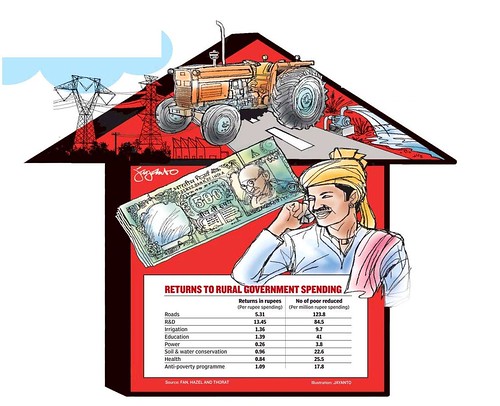
The table below the graphic quantifies hail every million rupee spent on roads and agriculturalR&Dsignificantlyreducespoverty liedhy environment, clean water and good sanitation affeet quality of life and longevity, the two biggest markers of human development. A 2007 field study by Chandigarh-based researchers, B K Pattanaik and Madan Mohan Singh, concludes on the basis of various health surveys that as high as about 70 per cent of rural mortality can be attributed to poor environmental conditions. Their study of a ‘total sanitation’ village in Kapurthala district shows that participation of the community, women and self-help groups play a more important role than just money The findings further underscore the importance of inelusily policies and good governence.

NCAERCs Rural infrastrature Report 2006, recommends a multi-pronged stratergy for the cash strapped Central and State governments.It recommends that 1ho Private Providers take care of telecom and power but a system of incentives, limited ownership and user charges be promoted for sectors like roads, drinking water and sanitation. In the case of the last mile of road connectivity, it recommends provision of building roads by village communities through targeted subsidies. It calls for dismantling legal barriers that prevent local investment in rural areas. The current legal system forbids village or town-leyel transporters, networks of telephone exchanges or water distributors from operating legally Manmohan Singh’s most ambitious initiative, Bharat Nirman, addresses many of these concerns but one hopes it does not meet the fate of the earlier rural development programmes that ended up as examples of inefficiency, corruption and bureaucratic meddlesomeness.

50% is rural India’s contribution to GDP but rural per capita income is 56% less than urban average as 25 lakh crore will be the size of Indian rural market in 20 years; four times the current urban market size The government’s plan for developing rural infrastructure over 4 years (2005-2009) . It is estimated to cost Rs 1,74,000 crore.

ROADS: Build 1.5 lakh km all weather roads for habitations over 500 people in hilly areas and over 1000 in other areas.

TELEPHONE: Equip 66,822 villages with telephones. Connect 14,183 remote villages by digital satellite phones

IRRIGATION: Create 1 crore hectare of irrigation potential. Restore 10 lakh hectare potential by renovation and modernisation of schemes.

DRINKING WATER: Cover 55,067 uncovered and 2.8 Iakh partially covered habitations. Give potable water to over 2 lakh villages.

HOUSING: Construct 60 lakh houses for the rural poor.

POWER: Electrify 1.25 lakh villages by grid supply.

ACCELERATED RURAL WATER SUPPLY PROGRAMME-1972-73 Accelerated the coverage of drinking water. Failed due to inadequate funding and lack of technical capacity of Zila Parishads to operate and maintain water supply and sanitation facilities .

INTEGRATED RURAL DEVELOPMENT PROGRAMME-1980 Provided rural poor subsidy and bank credit for productive employment. One-time provision of credit without follow-up, sub critical investments, over-crowding, and lack of market linkages weakened the scheme.

INDIRA AWAAS YOJANA-1985-86 Aimed to give free housing in rural areas, especially to SC/STs and bonded labourers. Failed due to limited coverage, resource constraints and leakages to undeserving candidates.

EMPLOYMENT ASSURANCE SCHEME -1993 Provided rural employment during lean agricultural season. Unsuccessful due to corruption and uneven distribution.

RADHIEKA MITTAL RETURNS TO RURA GOVERNMENT SPENDING Returns in rupees No of poor reduced (Per rupee spending) (Per million rupee spending) Roads 5.31 123.8 R & D 13.45 84.5 Irrigation 1.36 9.7 Education 1.39 41 Power 0.26 3.8 Soil & water conservation 0.96 22.6 Health 0.84 25.5 Anti-poverty programme 1.09 17.8 1 out of ten people on the planet is an Indian villager 2 km is the average distance from a village to an all weather road

Thanks To HT Media and their conent writers for such a wonderful report